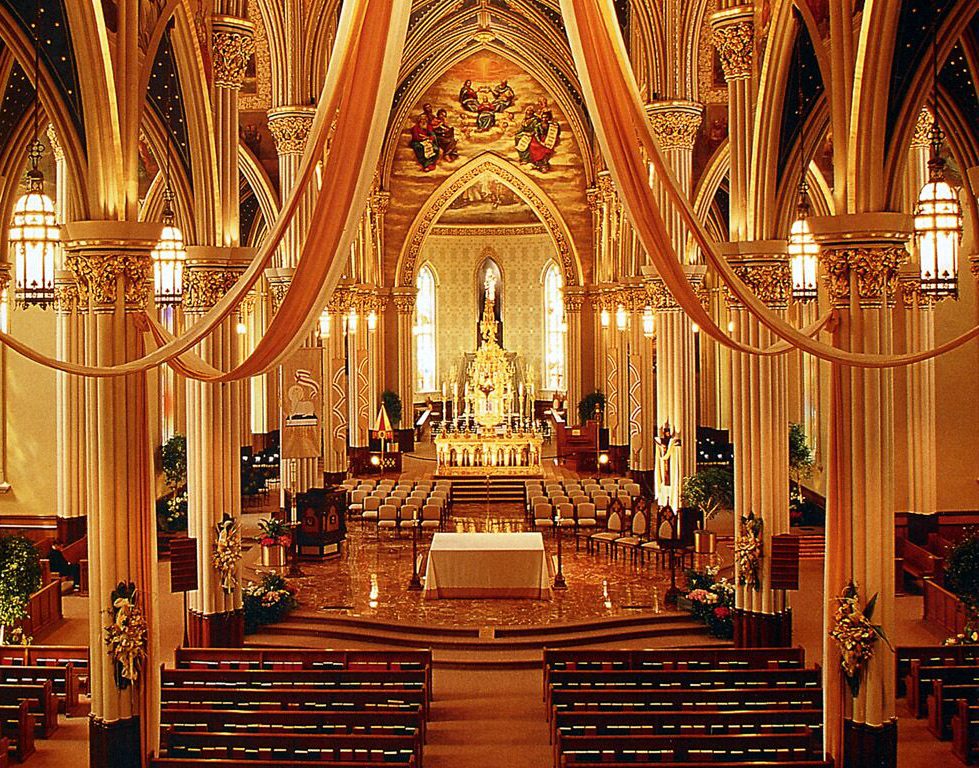
The tabernacle was first intended for the reservation of the Eucharist in a worthy place so that it could be brought to the sick and those absent outside of Mass. As faith in the real presence of Christ in his Eucharist deepened, the Church became conscious of the meaning of silent adoration of the Lord present under the Eucharistic species. It is for this reason that the tabernacle should be located in an especially worthy place in the church and should be constructed in such a way that it emphasizes and manifests the truth of the real presence of Christ in the Blessed Sacrament. (CCC, 1379)
Worship #23
Definition and synonyms of worship
Signs and Symbols #22
Signs and symbols
1145 A sacramental celebration is woven from signs and symbols. In keeping with the divine pedagogy of salvation, their meaning is rooted in the work of creation and in human culture, specified by the events of the Old Covenant and fully revealed in the person and work of Christ.
1146 Signs of the human world. In human life, signs and symbols occupy an important place. As a being at once body and spirit, man expresses and perceives spiritual realities through physical signs and symbols. As a social being, man needs signs and symbols to communicate with others, through language, gestures, and actions. The same holds true for his relationship with God.
1147 God speaks to man through the visible creation. The material cosmos is so presented to man’s intelligence that he can read there traces of its Creator.16 Light and darkness, wind and fire, water and earth, the tree and its fruit speak of God and symbolize both his greatness and his nearness.
1148 Inasmuch as they are creatures, these perceptible realities can become means of expressing the action of God who sanctifies men, and the action of men who offer worship to God. The same is true of signs and symbols taken from the social life of man: washing and anointing, breaking bread and sharing the cup can express the sanctifying presence of God and man’s gratitude toward his Creator.
Excerpt from the Catechism of the Catholic Church
Architecture #21
“We seek to restore the practice of a sacred architecture because it is part of our Catholic patrimony, in the same way that images of the Annunciation, Last Supper, and Crucifixion are. they are a catechism in paint, mosaic, and stone.” (Introduction, 1)
“By placing icons within aedicules, testers over the Blessed Sacrament, and baldacchinos over the altar, the architecture focuses our attention on the sacred elements.” (Introduction, 3).
Excerpts from The Church Building as a Sacred Place: Beauty, Transcendence, and the Eternal
Inspiration of the Bible #20
“God is the author of Sacred Scripture.”
Excerpt from 105, II. INSPIRATION AND TRUTH OF SACRED SCRIPTURE from the CCC
“In Sacred Scripture, God speaks to man in a human way.”
Excerpt from 109, III. THE HOLY SPIRIT, INTERPRETER OF SCRIPTURE from the CCC
Paintings #19
“For pictorial representation is made use of in Churches for this reason; that such as are ignorant of letters may at least read by looking at the walls what they cannot read in books.”
Excerpt from Epistle CV: to Serenus, Bishop of Massilia (Marseilles)
Beauty According to Cardinal Ratzinger #18
|
“Whoever believes in God, in the God who manifested himself, precisely in the altered appearance of Christ crucified as love “to the end” (Jn 13,1), knows that beauty is truth and truth beauty;”
|
|
MESSAGE OF HIS EMINENCE CARD. JOSEPH RATZINGER |
The Altar and Loving Others #17
This passage from the Bible talks about how if we do not love others, we do not love God.
As said in the previous post, altars have relics of saints that remind us of the communion of saints and of God’s love. Based on this passage, the altar’s relics also help us worship God because they help us love God. As alluded to in the last post, because the altar’s relics increase remembrance and devotion to saints, the relics help us to love others, like the saints, more. By loving others, we will love God. And in loving God, we will be able to worship Him in a deeper way. And like this Bible passage said, we cannot love God unless we love others.
Altar’s Relics #16
“However, in St. Peter’s during the pontificate of St. Gregory the Great (590–604), the altar was moved nearer to the bishop’s chair, probably for the simple reason that he was supposed to stand as much as possible above the tomb of St. Peter. This was an outward and visible expression of the truth that we celebrate the Sacrifice of the Lord in the communion of saints, a communion spanning all times and ages. The custom of erecting an altar above the tombs of the martyrs probably goes back a long way and is an outcome of the same motivation. Throughout history the martyrs continue Christ’s self-oblation; they are like the Church’s living altar, made not of stones but of men, who have become members of the Body of Christ and thus express a new kind of cultus: sacrifice is humanity becoming love with Christ.”
Thoughts: Having relics by and in altars, reminds people that God wants us to not only love Him, but love others as well. The fact that the altar reminds us of our membership in the communion of saints, helps us live out this love more deeply. It increases a feeling of kinship to think of those who have gone before us to God’s heavenly kingdom who are still helping us live our lives according to God’s will through prayer and intercession. Knowing that God loves others so much and wants us to love others too, gives insight into His love. This fact clarifies how all-consuming His love is for everyone, and it reaffirms how He is a community of love. His love for everyone helps to prove how He is Love. By giving us deeper insight into the love of God, altars and their relics help us worship God with more devotion and love.
Excerpt from Sacred Places: The Altar and the Direction of Liturgical Prayer from The Spirit of the Liturgy
The Main Altar #15
“… it shall occupy a place in the sacred building which is truly central, so that the attention of the whole congregation of the faithful is spontaneously turned to it.”
Thoughts: This excerpt reveals how important the altar is in a church. It occupies a very prominent place in the church. The only reason a thing would be important in a church is if it greatly reflected God or helped people worship Him. In this case, the altar is the place on which God becomes physically present in the Eucharist. There is no better way to grow in a deeper relationship with God than to be physically with Him. In knowing God better, one realizes more deeply His Goodness, Beauty, and Perfection. This realization leads to more personal and meaningful worship of God.
Excerpt from “The Proper Construction of Churches and Altars in order to Facilitate the Active Participation of the Faithful,” the Instruction for the Proper Implementation of the Constitution on the Sacred Liturgy. This excerpt was found in
BAYNE, W. W. “Liturgical Art, History of.” New Catholic Encyclopedia, 2nd ed., vol. 8, Gale, 2003, pp. 618-638. Gale Virtual Reference Library, http://link.galegroup.com.aapld.idm.oclc.org/apps/doc/CX3407706766/GVRL?u=algo36745&sid=GVRL&xid=fdd3e383. Accessed 8 Jan. 2019.
 Carmella's Capstone