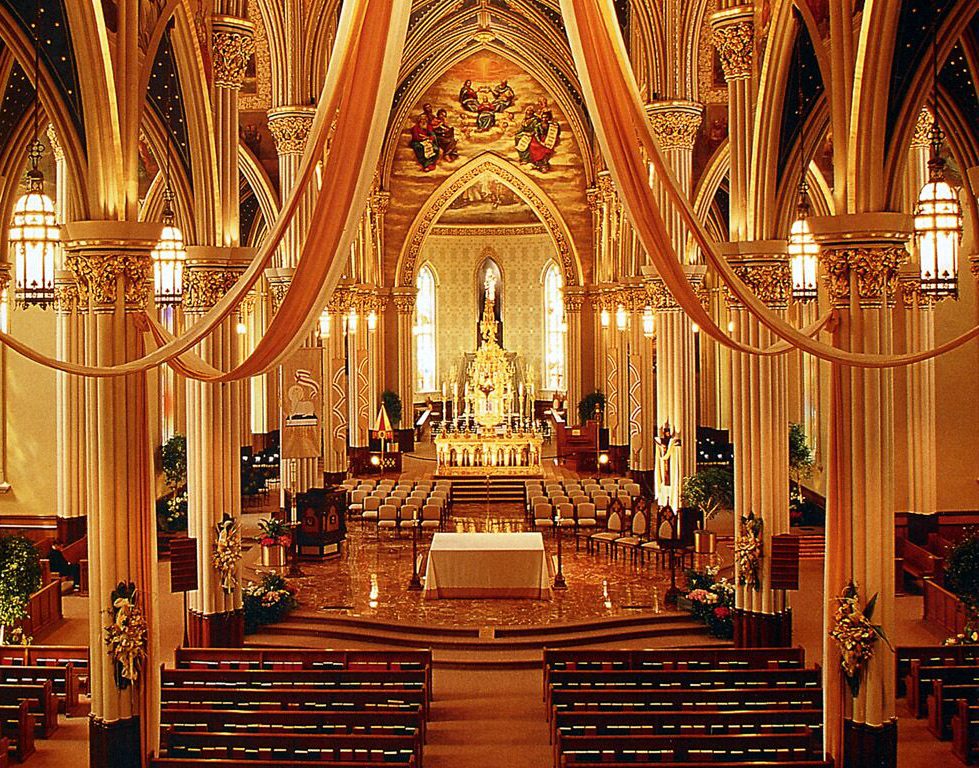
“In his De Musica, Augustine proposed that numerical ratios are but the echoes of the perfection of God. In music these ratios are audible; in architecture they are visible. The most admirable ratio is 1:1 since here the unity of relationship is equal and perfect; then came 1:2, 2:3, 3:4. Through the contemplation of the visible configurations of architecture, the mind is led to proportion, from proportion to number, and from number to the idea of God. This thesis of perfect ratio became the first purely mediate religious symbol in Western church architecture” (673).
The Renaissance focused on this symbolism and therefore rejected the previous basilica plan because it was mathematically and therefore architecturally imperfect. Instead, they preferred the “central plan” or circle plan “in which geometric pattern generates the form with all its parts; this provides a most lucid, absolute, and immutable architecture” (674). This architecture raises people’s thoughts to an “absolute” and “immutable” God (674). “For [L.B. Alberti, A. Palladio, and Serlio] the regulation of all parts of a church according to these ratios could manifest something of the nature of God” (674).
Citation:
WALL, D. R., et al. “Church Architecture, History of.” New Catholic Encyclopedia, 2nd ed., vol. 3, Gale, 2003, pp. 669-718. Gale Virtual Reference Library, http://link.galegroup.com.aapld.idm.oclc.org/apps/doc/CX3407702431/GVRL?u=algo36745&sid=GVRL&xid=4d3c5c37. Accessed 30 Nov. 2018.
 Carmella's Capstone