The Tabernacle Reflects God #14

The Tabernacle Reflects God #14

In Chapters 25 – 26 of the Bible, the Lord tells Moses to make a “sanctuary” for God so that He can “dwell in their midst.” God then proceeds to tell Moses the specifications for the Ark of the Covenant. Much like the Ark of the Covenant, tabernacles today are made from precious metals such as gold. Some are even veiled in similarity with the Ark of the Covenant.

Thoughts: Therefore, the tabernacle represents something that God wanted to exist, the Ark of the Covenant. The Ark of the Covenant held God’s presence for the Israelites and now the tabernacle holds God’s presence in the Eucharist. By knowing that God desired to have something like a tabernacle to hold Him, we know more about God’s desires and therefore know more about Him as a Being. In addition, the tabernacle’s beauty reflects God’s Beauty. The ornateness reflects God’s immeasurable worth, importance, and supremacy.

What Churches Should Contain #13

What Churches Should Contain #13

“Therefore, churches or other places should be suitable for carrying out the sacred action and for ensuring the active participation of the faithful. Moreover, sacred buildings and requisites for divine worship should be truly worthy and beautiful and be signs and symbols of heavenly realities.[107]

289. Consequently, the Church constantly seeks the noble assistance of the arts and admits the artistic expressions of all peoples and regions.[108] In fact, just as she is intent on preserving the works of art and the artistic treasures handed down from past centuries[109] and, in so far as necessary, on adapting them to new needs, so also she strives to promote new works of art that are in harmony with the character of each successive age.[110]”

A church should also have an altar, ambo, “Chair for the Priest Celebrant and Other Seats,” “Places for the Faithful,” “Place for the Schola Cantorum and the Musical Instruments,” “Place for the Reservation of the Most Holy Eucharist,” and “Sacred Images.”

The schola cantorum is the church choir.

Information and excerpt from Chapter V of the General Instruction of the Roman Missal

Purpose of Churches #12

Purpose of Churches #12

“751 The word ‘Church’ (Latin ecclesia, from the Greek ek-ka-lein, to ‘call out of’) means a convocation or an assembly. It designates the assemblies of the people, usually for a religious purpose.139 Ekklesia is used frequently in the Greek Old Testament for the assembly of the Chosen People before God, above all for their assembly on Mount Sinai where Israel received the Law and was established by God as his holy people.140 By calling itself ‘Church,’ the first community of Christian believers recognized itself as heir to that assembly. In the Church, God is ‘calling together’ his people from all the ends of the earth. The equivalent Greek term Kyriake, from which the English word Church and the German Kirche are derived, means ‘what belongs to the Lord.’

752 In Christian usage, the word ‘church’ designates the liturgical assembly,141 but also the local community142 or the whole universal community of believers.143 These three meanings are inseparable. ‘The Church’ is the People that God gathers in the whole world. She exists in local communities and is made real as a liturgical, above all a Eucharistic, assembly. She draws her life from the word and the Body of Christ and so herself becomes Christ’s Body.”

If a church is “the assemblies of the people, usually for a religious purpose,” then a church that raises the mind to the God of that religion and therefore to the religion itself is an effective church. The fact that the word “Kyriake, from which the English word Church and the German Kirche are derived, means ‘what belongs to the Lord,'” shows that a church should center thought on God, His attributes, and what is His.

Excerpt from ARTICLE 9 “I BELIEVE IN THE HOLY CATHOLIC CHURCH”, Paragraph 1. The Church in God’s Plan, I. NAMES AND IMAGES OF THE CHURCH from the Catechism of the Catholic Church
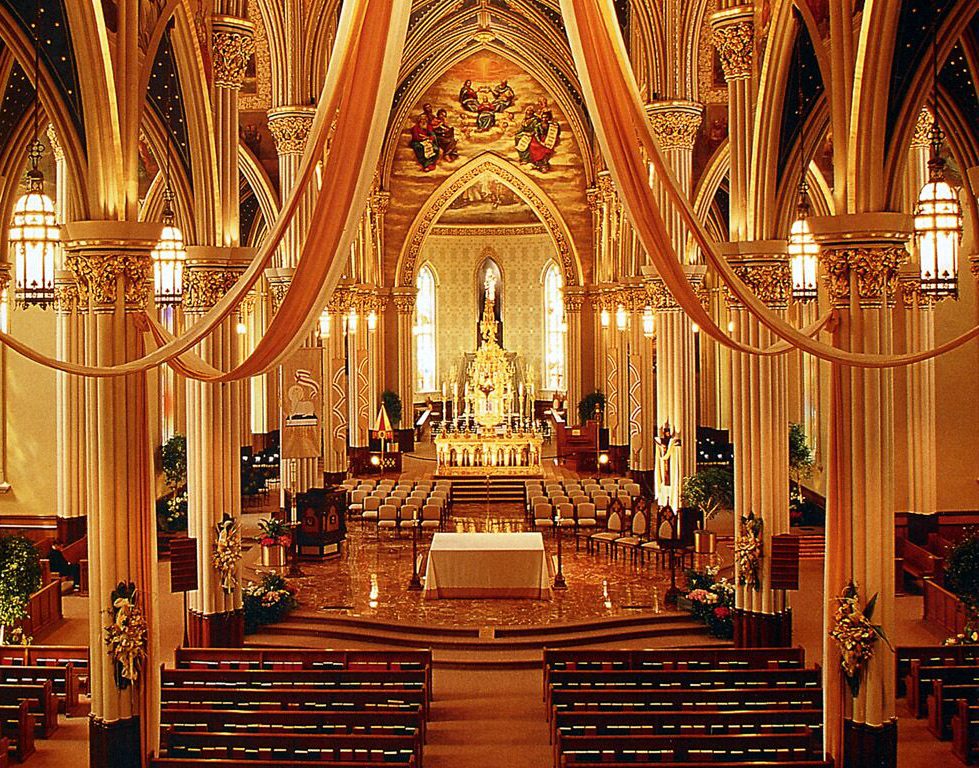
Light Symbolism in Church Architecture #11

Light Symbolism in Church Architecture #11

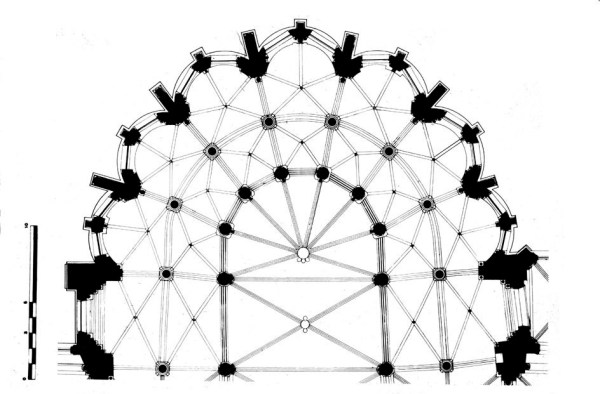
Pseudo-Dionysius asserted that all of creation is ordered in a hierarchy where the creation that possesses the most light is at the top. He said that creation is “an act of illumination” (674). Pseudo-Dionysius inspired the renovation plan of the Abbey of Saint-Denis’ chevet to be one that allows a lot of light to enter the abbey. Robert Grosseteste proposed that Aristotle’s concepts of matter and form were brought together in light. He claimed that form “is a perfect unity and is represented by the number one; matter by the number two; the accord of form and matter by the number three; the composite itself by the number four” (674). He said that from these numbers come proportions that bring harmony. “…man may then contemplate God through these harmonies” (674).

Floor Plan of The Abbey of Saint-Denis’ Chevet:

Image from Medieval Art from www2.oberlin.edu

Citation:

WALL, D. R., et al. “Church Architecture, History of.” New Catholic Encyclopedia, 2nd ed., vol. 3, Gale, 2003, pp. 669-718. Gale Virtual Reference Library, http://link.galegroup.com.aapld.idm.oclc.org/apps/doc/CX3407702431/GVRL?u=algo36745&sid=GVRL&xid=4d3c5c37. Accessed 30 Nov. 2018.

Number Symbolism in Church Architecture #10

Number Symbolism in Church Architecture #10

“In his De Musica, Augustine proposed that numerical ratios are but the echoes of the perfection of God. In music these ratios are audible; in architecture they are visible. The most admirable ratio is 1:1 since here the unity of relationship is equal and perfect; then came 1:2, 2:3, 3:4. Through the contemplation of the visible configurations of architecture, the mind is led to proportion, from proportion to number, and from number to the idea of God. This thesis of perfect ratio became the first purely mediate religious symbol in Western church architecture” (673).

The Renaissance focused on this symbolism and therefore rejected the previous basilica plan because it was mathematically and therefore architecturally imperfect. Instead, they preferred the “central plan” or circle plan “in which geometric pattern generates the form with all its parts; this provides a most lucid, absolute, and immutable architecture” (674). This architecture raises people’s thoughts to an “absolute” and “immutable” God (674). “For [L.B. Alberti, A. Palladio, and Serlio] the regulation of all parts of a church according to these ratios could manifest something of the nature of God” (674).

Citation:

WALL, D. R., et al. “Church Architecture, History of.” New Catholic Encyclopedia, 2nd ed., vol. 3, Gale, 2003, pp. 669-718. Gale Virtual Reference Library, http://link.galegroup.com.aapld.idm.oclc.org/apps/doc/CX3407702431/GVRL?u=algo36745&sid=GVRL&xid=4d3c5c37. Accessed 30 Nov. 2018.

Jesus on the Body and the Soul #9

Jesus on the Body and the Soul #9

Matthew 5:29

“If your right eye causes you to sin, tear it out and throw it away.s It is better for you to lose one of your members than to have your whole body thrown into Gehenna.”

This passage shows the intimate connection between body and soul. Jesus’ statement implies that the body has great affect on the soul. For the body can cause one to sin. It then follows that if the body can cause the soul to be in a state of sin, the body can also cause the soul to grow in virtue. Therefore, physical things like religious art can help a person grow in holiness.

A Woman Anoints Jesus’ Feet #8

A Woman Anoints Jesus’ Feet #8

John 12:1-8

A woman uses expensive oil to anoint Jesus’ feet. When she is rebuked by Judas, who claims that she should have sold it and given the money to the poor, Jesus says, “Leave her alone. Let her keep this for the day of my burial. You always have the poor with you, but you do not always have me.”

This passage shows that it is ethical to give money and expensive things to God for His glory instead of giving it to the poor as long as you give to the poor at other times. “You always have the poor with you,” implies that you can give money to the poor at another time.

Citation:

The New American Bible. Revised ed., Confraternity of Christian Doctorine, Inc., 2010.

Within Reason #7

Within Reason #7

While it is true that we should have exquisite churches, it is important to put it into perspective. If one is in a very impoverished area, it would be better to give most of the money to the people. A person in dire need of water and food needs that water and food before they need a beautiful church. It is better for a person to be alive without a beautiful church and to be able to progress in the spiritual life through prayer and sacrifice than for a person who is dead to have A beautiful church but be unable to advance in the spiritual life. A beautiful church is meant to help a person’s spiritual life progress, and one’s spiritual life can progress in other ways. A simple church can be built and art, gold accents, etc. can be added later when the area is doing financially better. In the mean time, prayers can be taught and Masses can be said to improve spiritual lives while their physical lives are stabilized. In some cases, the people in this area may choose to go without in order to have a beautiful church because they recognize how important their spiritual lives are and how necessary churches are for that spiritual life. Once the people in need of immediate aid are helped, then beautiful churches should be built because, “An increased sense of God and increased self-awareness are fundamental to any full development of human society. This development multiplies material goods and puts them at the service of the person and his freedom. It reduces dire poverty and economic exploitation. It makes for growth in respect for cultural identities and openness to the transcendent.229” When most people in an area are financially stable and money is already being given to help those in need, it is ethical and even necessary to build exquisite churches to encourage and help people along their spiritual journey.

Excerpt from Justice and Solidarity Among Nations from the Catechism of the Catholic Church
Man Is Body and Soul #6

Man Is Body and Soul #6

“The unity of soul and body is so profound that one has to consider the soul to be the ‘form’ of the body: [^234] i.e., it is because of its spiritual soul that the body made of matter becomes a living, human body; spirit and matter, in man, are not two natures united, but rather their union forms a single nature.”

Thoughts Inspired from Text: Since man is a “unity of soul and body”, What happens to the soul affects the body and vice versa. Because of this connection, the body affects the spiritual life, or life of the soul. Therefore, in order to move forward in spiritual life, one has to physically do things so that their bodies, not just their souls, are focused on God. Having beautiful churches helps us in this regard. The churches, in their architecture and art, give our bodies something to look at and focus on so our entire being is focused on God. Therefore, in order to help people advance in their spiritual lives, we need beautiful churches.

Excerpt from “BODY AND SOUL BUT TRULY ONE” from the Catechism of the Catholic Church

Beauty #5

Beauty #5

“For beauty includes three conditions, ‘integrity’ or ‘perfection,’ since those things which are impaired are by the very fact ugly; due ‘proportion’ or ‘harmony’; and lastly, ‘brightness’ or ‘clarity,’ whence things are called beautiful which have a bright color.”

Thoughts: Art in churches represent God. They often contain images depicting God’s beauty and goodness. Because they reflect Truth, they are beautiful. Even things like ornate architecture are beautiful because they reflect perfection in craftsmanship and skill. Perfection reflects God so in this way even architecture is beautiful.

Excerpt from Summa Theologica, Part I, Question 39, Eighth Article, I answer that